Upcoming moon phases
Lunar calendar
The moon phase for every night of the month (at 10 p.m.), with the day of each main phase: new moon, first quarter, full moon and last quarter. Use ‹ and › to change month. It’s the phase, not whether you’ll see it: that depends on when it rises and on the weather.
The phases of the moon
The Moon has no light of its own: the Sun lights it, and depending on where it is on its trip around the Earth we see more or less of its sunlit side. There are four main phases (new moon, first quarter, full moon and last quarter) and four in-between ones.
| Phase | Illuminated | Days after new moon | When you can see it |
|---|---|---|---|
| New Moon | 0% | 0 | Not visible: it’s on the Sun’s side of the sky and rises and sets with it. |
| Waxing Crescent | 1–49% | 1–6 | A thin sliver after sunset, low in the west, growing each night. |
| First Quarter | 50% | about 7 | Half moon. Rises around noon and sets around midnight: afternoon and early night. |
| Waxing Gibbous | 51–99% | 8–14 | More than half. Rises in the afternoon; visible from dusk until the small hours. |
| Full Moon | 100% | about 15 | The whole disc. Rises at sunset and sets at sunrise: all night long. |
| Waning Gibbous | 99–51% | 16–21 | Rises after dark and stays up into the morning. |
| Last Quarter | 50% | about 22 | The other half. Rises around midnight: late night and morning. |
| Waning Crescent | 49–1% | 23–29 | A sliver before dawn, in the east, until the next new moon. |
How long the lunar cycle lasts
The phases repeat every 29 days, 12 hours and 44 minutes on average (the synodic month), and each cycle can be a few hours longer or shorter. That’s more than the 27.3 days the Moon takes to orbit the Earth because, meanwhile, the Earth has moved along its own orbit around the Sun, and the Moon needs about two more days to line up with the Sun at the same angle again.
The main phases are moments, not whole days: the instant the Moon lines up with the Sun (new), sits at a right angle to it (the quarters) or is on the opposite side (full). That’s why this page gives each one a date, worked out in your device’s time zone.
The Moon always shows us the same face: the dark patches you see with the naked eye are its «seas», plains of old lava. One of them is the Sea of Tranquility, where Apollo 11 landed.
How the moon looks from each hemisphere
from the Northern Hemisphere
from the Southern Hemisphere
The phase is the same for the whole planet at the same instant, but it doesn’t look the same everywhere. From the Southern Hemisphere you see the Moon upside down compared with the north: a waxing moon is lit on the left and a waning moon on the right; in the north it’s the other way round. The dark markings on its face are turned around too.
In the Northern Hemisphere, remember DOC: a waxing moon is shaped like a D, a full moon like an O and a waning moon like a C. South of the equator it flips. Near the equator, a crescent lies almost flat, like a boat.
This page (and the app) guesses your hemisphere from your device’s time zone, without asking for your location. If you’re traveling with another place’s time on your phone, or you’re very close to the equator, the drawing may not match what you see in the sky; the dates and the percentage still do.
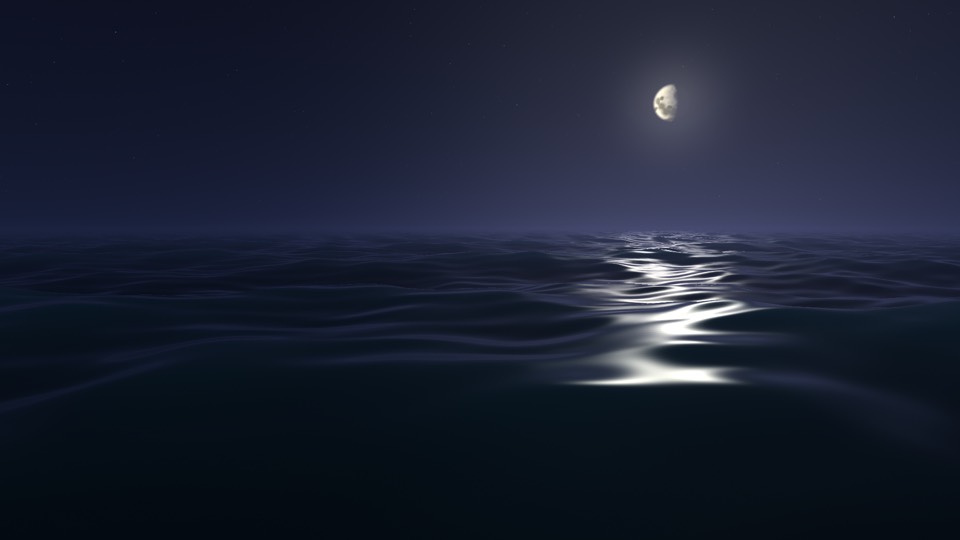
Today’s moon, over the sea
In Sea of Tranquility, the moon in the sky has today’s phase. Press play: breathe in as the wave rises, breathe out as it falls.
Note: the app copies only the phase. It doesn’t show where the moon is in your sky, when it rises or sets, or whether you can see it tonight: it’s always night there, and the moon is always in the same spot.
The open sea and the beach are free in the Apple TV app.
This is the app, drawing itself live in your browser.
Why the app copies only the phase
The phase is the same for everyone at the same instant, so the date is enough to work it out: no location, no account and no internet. In the app, the moon in the sky has today’s phase, lit on the side that matches your hemisphere, and its glow and its reflection on the water get stronger the fuller it is.
Where the moon is in your sky, when it rises and whether you can see it tonight depend on exactly where you are, the time and the clouds; that would take your coordinates, and Sea of Tranquility doesn’t ask for them. It isn’t an astronomy app either: it’s a landscape to breathe with, following a wave, and the moon always appears at night, in the same spot. Beyond the sea, you can also breathe on the surface of Mars or among the rings of Saturn.
FAQ
What does «80% illuminated» mean?
How much of the Moon’s disc, as we see it, is lit by the Sun. At 50% it’s a half moon (first or last quarter); at 100%, a full moon; close to 0%, a new moon.
How many phases does the moon have?
Four main ones: new moon, first quarter, full moon and last quarter. Between them come four in-between phases (waxing crescent, waxing gibbous, waning gibbous and waning crescent), which is why people also talk about eight phases.
How long does each moon phase last?
The main phases are an instant: the full moon, for example, is the moment the Moon is exactly opposite the Sun. About 7.4 days pass between one main phase and the next. To the eye the change is slow: a day before and a day after the full moon, it already looks almost full.
How often is there a full moon?
About every 29.5 days: the time the Moon takes to go through all its phases. That’s why a month sometimes has two full moons.
How many full moons are there in a year?
Twelve or thirteen. Twelve cycles of phases add up to about 354 days, eleven short of a year, so every two or three years there’s an extra full moon. The second full moon in a calendar month is often called a «blue moon».
How can I tell if the moon is waxing or waning?
Look at which side is lit. In the Northern Hemisphere a waxing moon is lit on the right, like a D, and a waning moon on the left, like a C; in the Southern Hemisphere it’s the other way round. Another clue that works anywhere: a waxing moon is easiest to see in the afternoon and evening, a waning moon late at night and in the morning.
Why does the moon look upside down in the Southern Hemisphere?
Because from the south you see it turned around compared with the north: a waxing moon is lit on the left in the south and on the right in the north. This page guesses your hemisphere from your device’s time zone, so the orientation is approximate.
Is the full moon on the same day everywhere?
It’s the same instant all over the planet, but the date depends on the time zone: a full moon at 2 a.m. in New York is still the evening before in Los Angeles. That’s why this page gives dates in your device’s time zone.
Why can I sometimes see the moon during the day?
Because for most of the cycle it spends some hours above the horizon in daylight. It’s easiest near the quarters: the first quarter in the afternoon, the last quarter in the morning. The new moon can’t be seen, because it’s on the Sun’s side of the sky.
What is the Sea of Tranquility?
A dark plain on the Moon, made of solidified lava, that you can see with the naked eye. Apollo 11 landed there in 1969. This app is named after it (in Spanish, Mar de Tranquilidad).
Is the moon in the app where I see it in the sky?
No. Sea of Tranquility copies only today’s phase (how much is lit and on which side). It doesn’t show the Moon’s real position, when it rises or sets, or whether you can see it from where you are: in the app it’s always night and the moon is always in the same spot in the landscape.
How accurate is the calculation?
It uses Jean Meeus’s formulas (Astronomical Algorithms), with no internet. The illuminated percentage is within one point of the real one, and the time of each phase within half an hour (checked against published ephemerides); if a phase falls near midnight, the day can shift.